
St. Louis County Resident Lookup Records
St. Louis County does not have one verified official search covering all residents. The practical route starts with the clue already in hand and keeps each result in its own record role. A parcel field is not an occupancy finding. A court case is not a final outcome. A library index is a finding aid, not a certificate. The table identifies what each official or local source can actually confirm.
| Record | What It Confirms | Where | Access |
|---|---|---|---|
| Parcel and address record | Mapped parcel, physical address, and property fields | County Property Search and Land Explorer | Public web search; not proof of occupancy |
| Court case record | Case, filing, role, status, register of actions, and eligible documents | Minnesota Case Search | Remote results are unofficial; local terminals are more complete |
| Historical library finding aids | Dated directory, obituary, death, birth, marriage, or newspaper lead | Duluth Library genealogy indexes | Public indexes; underlying source still controls |
| Vital record | Eligible birth, death, marriage, divorce, or adoption event | County vital office or MDH Vital Records | Statutory eligibility and copy rules apply |
| Credential record | Credential-holder or entity status | MDH, DLI, eLicense, or Secretary of State route | Purpose-specific; not proof of residence |
Start with an address in the parcel and GIS systems, a case number in MCRO, an event through the issuing authority, or a dated name in the library records. A common name plus a county is not enough to join results.
St. Louis County Lookup Routes by Clue
For an address, first validate the street, city, and ZIP with USPS, then use the Assessor Property Search or Land Explorer for the parcel and legal geography. Recorded instruments are in RecordEASE, while directories, permits, and newspapers can supply historical context. For a name with a historical date, the Duluth directories, obituary and death indexes, MOMS, newspapers, census, and digitized directory images are better starting points than a current parcel card.
For a court event, use the case number where available or narrow a name search with date, category, and St. Louis County court location. For a marriage, request a certificate from the county that issued the license. A divorce decree comes from the district court that granted it. Those jurisdiction differences prevent a resident lookup from becoming a loose collection of unrelated hits.
MCRO Fields for a Resident Lookup
Minnesota Case Search offers Name, Case Number, Citation Number, and Attorney paths. The name screen supports exact or trailing-asterisk searching after two characters, a Sounds Like option, last, first, and middle names, date-of-birth and filing-date fields, category, status, and court-location controls. Choose St. Louis County only when the case geography is known. A name hit should be paired with a case number, filing date, location, and register-of-actions review.
| Field | Type | Use | Important limit |
|---|---|---|---|
| Last, first, middle name | Text | Find a party or business | Common names and variants can mislead |
| DOB and date filed | Exact or date range | Narrow a name search | Use only where lawfully available |
| Category, status, location | Checkbox or select | Limit results to a known case context | Case type is not final outcome |
| Case, citation, or attorney number | Text | Reach a known record | Each path describes a different connection |
The MCRO overview says remote documents are primarily available from July 1, 2015 forward, with some remotely accessible orders, judgments, opinions, and notices from July 1, 2005 through June 30, 2015. Remote results omit party street addresses and comments, and protected case categories have further exclusions. Certified copies come from the local court.
The MCRO Case Search interface shows why the filters must be used together.
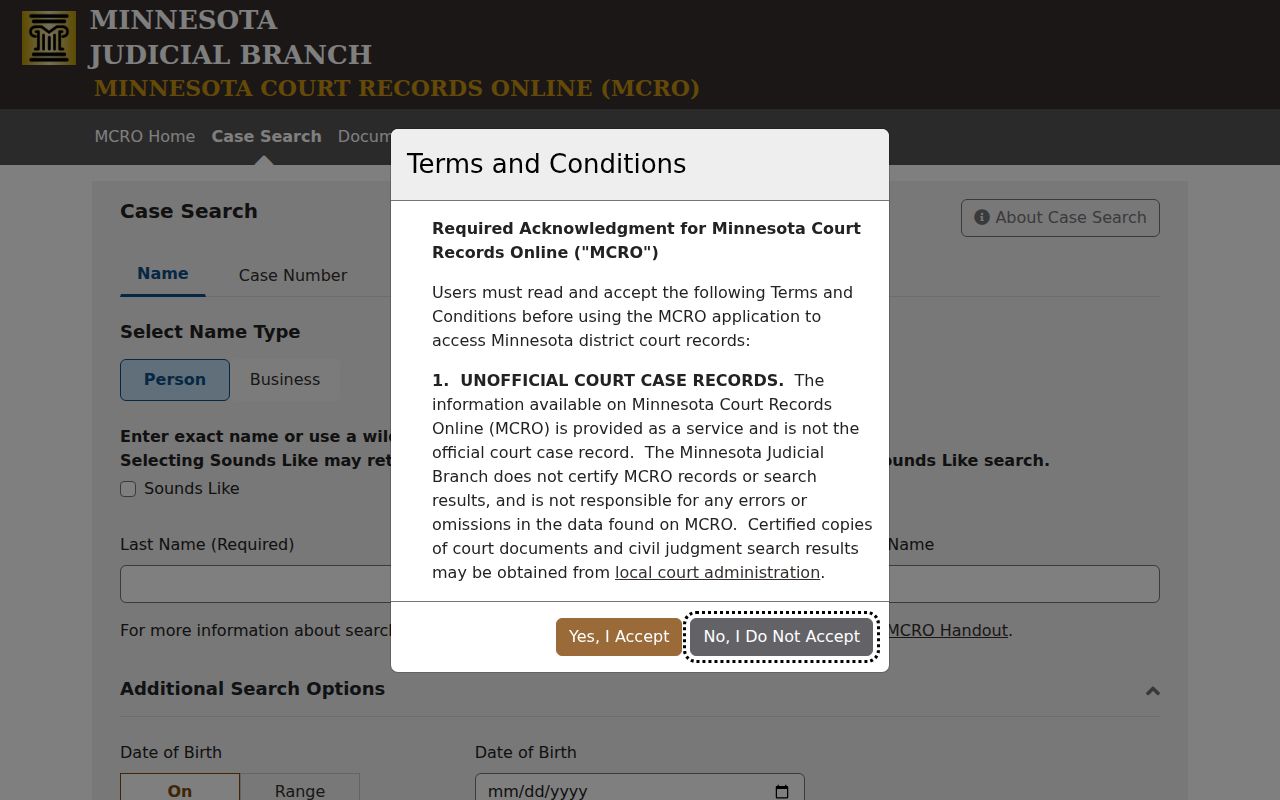
The screen represents a court-record search, not a general identity report. Its result remains unofficial until a court-certified record is obtained where one is needed.
Verify a St. Louis County Resident Record
Verification becomes stronger when each source answers a separate question. An address point anchors a place. A directory anchors a printed name in a year. A case number anchors a court matter. A certificate, when an eligible requester obtains one, anchors an event. Do not convert the label from one system into a claim from another.
- Write down the known name, date range, place, and the purpose of the record request.
- Use the narrowest primary source, such as a parcel for geography, a directory for a historical listing, or a case number for a court file.
- Capture the date checked, exact field, source role, and identifier, while leaving protected details out of the note.
- Test a second independent source for spelling, time, place, and role. Record any conflict rather than forcing a match.
- Ask the custodian for a certified or fuller record only when the source rules permit the request.
- Docket
- A court’s running list of filed events, hearings, orders, and other case actions, often shown through the register of actions.
- Index versus image
- An index points to a record. An image is a copy of the underlying item when the custodian makes it available. Access can differ.
- Certified copy
- A custodian-issued copy that carries the certification required by that office. A remote screen is not a substitute.
Historical St. Louis County Resident Lookup Evidence
Duluth Public Library offers a particularly useful historical route. Its local indexes include the Duluth Area Obituary Index from 1944 forward, the St. Louis County Death Index from 1870 through 2000, birth and biography finding aids, MOMS marriage material, and city-directory resources. Each result should lead back to the stated newspaper, certificate, directory image, or archival record rather than becoming a standalone conclusion.
A historical name can be tested with a dated street, occupation, parent or spouse field, certificate number, or census context. The Directory Book has the Duluth year runs, missing volumes, and 1930 street-listing change. That chronology is critical when an old address is the only shared fact.
Vital Routes in a Resident Lookup
MDH is the statewide vital-record hub, but it does not record marriages or divorces. Marriage certificates come from the county that issued the license. Divorce decrees come from the district court that granted the divorce. Birth and death copies can be requested from MDH or a Minnesota county vital-records office, subject to Minn. Stat. § 144.225, requester eligibility, identification, notarization, and delivery rules.
St. Louis County’s marriage request route asks for both applicants’ pre-marriage names, the marriage date and city, and optional book, page, or document number. The county lists $9 for the first and each additional copy and a one- to two-week timeframe. MOMS is a marriage finding aid, not a certificate. MDH’s original birth records remain sealed in adoption matters, though Minnesota-born adoptees age 18 or older have an official route for a noncertified original birth record under the July 2024 law. Contact preferences and other statutory conditions still apply.
St. Louis County Custody Systems Differ
A county jail roster, Minnesota DOC search, Minnesota VINE notification service, BCA self-record route, and a court case search are different systems. The county jail roster is an hourly snapshot. DOC covers people committed to the Commissioner who remain under DOC jurisdiction. VINE updates every 15 minutes for participating custody events. A missing result in any one system does not establish the absence of a record elsewhere.
The BCA public-record guidance describes a state-only self-record route and separate authorized checks. The listed self-record fee is $8; the BCA says its official fee page should be reviewed before a request. It is a separate state criminal-history process, not a court docket or jail search.
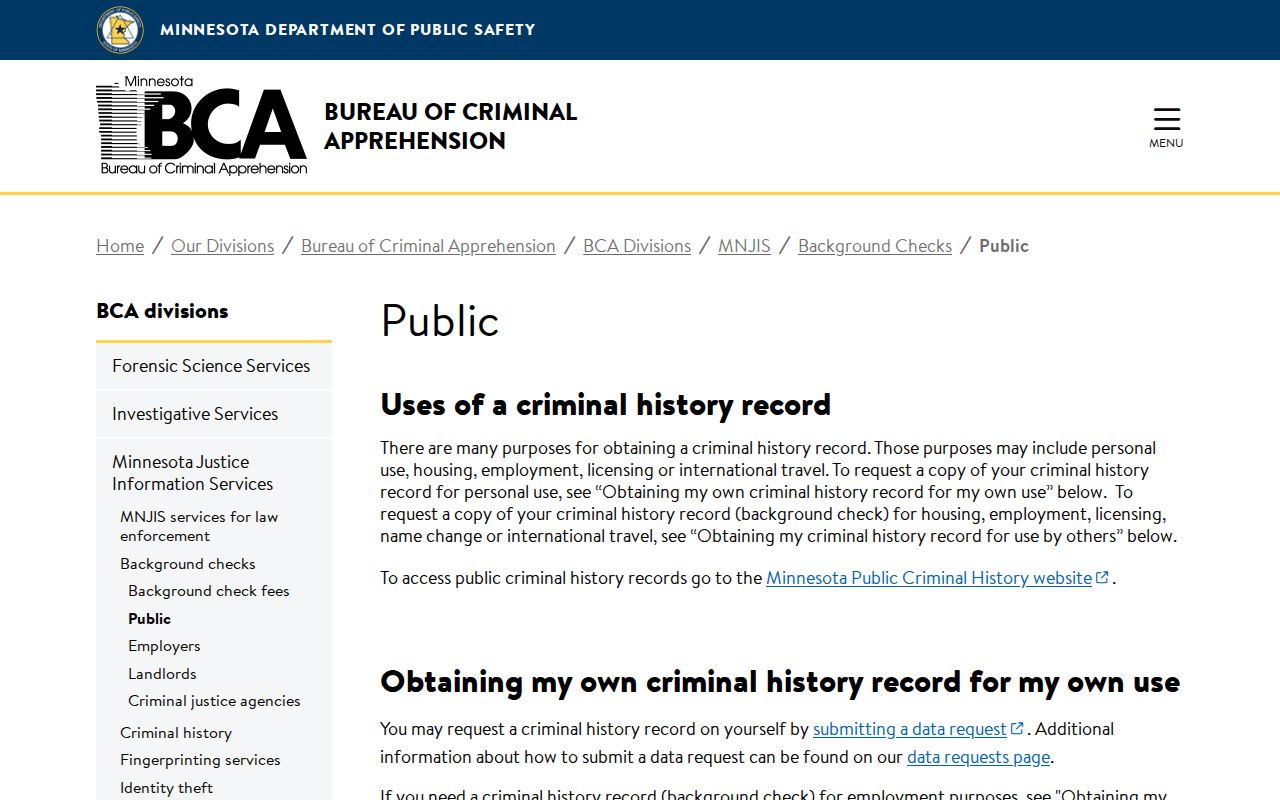
The BCA guidance reinforces the need to identify the exact record system before asking for information. It does not merge custody, court, and criminal-history records into one conclusion.
Minnesota DOC’s individual and fugitive search provides the state custody route.
The DOC service is limited to its stated jurisdiction. It should be timestamped and kept separate from an hourly county roster or a VINE notification.
Chapter 13 Resident Lookup Requests
Minnesota’s Government Data Practices Act, Minn. Stat. ch. 13, starts with public government data unless another law classifies it differently. Under § 13.03, inspection is free, copies may carry actual retrieval, copy, certification, or electronic-transmission costs, and an agency need not create a new record. Ask for an existing defined record, its date range, and inspection or copies. If information is withheld, request the classification and redaction explanation from the responsible authority.
Duluth’s City Clerk provides a public-data request route by online submission, email, mail, or hand delivery. State that the request is under Chapter 13, identify the record, and accept lawful redactions. A request is not a route to a custom countywide resident list.
Limits on a St. Louis County Resident Lookup
Voter status is a personal election-service tool, while a public information list has certification, use, and internet-publication restrictions under Minn. Stat. § 201.091. Safe at Home provides a designated address and mail forwarding for eligible people with safety concerns; program data are private. MCRO omits party street addresses and excludes certain protected matters from remote display. Do not try to reconstruct protected addresses from partial records.
For credentials, MDH and DLI systems describe a credential-holder or status, not a complete resident profile. For a parcel, an owner or tax name is not necessarily the occupant. A historical directory is a dated printing, not a current-status claim. These limits protect both accuracy and the person behind the record.